Tuesday, October 28, 2014

November

What is Disciplinary Literacy? 

How is disciplinary literacy different than content area literacy?


Are you interested in:
  • Strengthening your understanding of what it takes to engage students in deeper learning through disciplinary literacy practices;
  • Engaging in disciplinary literacy practices (e.g., close reading, digital learning, constructing and supporting claims);
  • Experiencing multiple opportunities for personalized application of disciplinary literacy to your teaching context;
  • Taking action to become a teacher leader by engaging others in disciplinary literacy practices.

Consider attending our Writing Collaborative and Reading Apprenticeship trainings if you haven't already (described below).  Already trained in RA and WC?  Then contact me to learn more about monthly meetings to support disciplinary writing with Writing Collaborative and disciplinary reading with Reading Apprenticeship. 

Upcoming Literacy Professional Development

Winter K-12 Literacy Summit

Socially and Culturally Relevant Literacy

Dr. Ernest Morrell of Teacher's College of Columbia University  

January 21, 2015
9:00-3:00
WISD

      Finding effective ways to teach today’s student population is perhaps the greatest challenge facing literacy educators in the United States. As classrooms become increasingly diverse, educators struggle to find curricula and pedagogical strategies that are inclusive and affirmative yet facilitate the development of academic and critical literacies. Much of the multicultural education literature has limited conceptions of culture as a racial or ethnic identity. Teachers have little help on creating learning communities in multiethnic classrooms (Mc,Carthy, 1998).
     Join Dr. Morrell to learn about new approaches for critical reading of popular culture to help all students deconstruct dominant narratives in the teaching of literacy.


Writing Collaborative

Helping teachers and students understand writing in the content areas in order to make explicit the processes and strategies needed to improve student writing, including:

-What we do when we write
-Practice of successful writers
-Helping students measure metacognition
-Four sure things teachers can do to improve student writing

All trainings are three days in length: 
  • Winter 2015- February 25, 26, and March 12
REGISTER HERE

*********************************************************

Reading Apprenticeship


Participants will:

1. Learn about the RA framework and
    instructional practices that support students'
     reading improvement.
    2. Develop and refine their own classroom
        practices in RA.
      3. Learn powerful instructional strategies
         that support content-area reading, writing,
         and thinking.
        4. Learn a set of rich routines to support the
           'metacognitive' conversation at the heart of RA.

        Training- Winter 2015: February 3, 4 and 24.   REGISTER HERE


        Writing in the World Language Classroom: Where there are words, there is magic!

        February 10, 2015
        8:30-3:30 at WISD 

        Writing in another language involves much more than translating and completing homework assignments from the text.  Writing is a powerful skill through which students express themselves in the new language.  This workshop addresses the national and state standards for written communication, compares those standards with common core expectations for writing, and explores a variety of real-world writing tasks and strategies at the word, phrase, sentence and paragraph level across a range of proficiency levels.

        Presenter:  

        Anne Grundstrom Nerenz, Ph.D.
        Editor, Foreign Language Annals
        Director, K-12 World Language Teacher Certification
        Eastern Michigan University
        Register HERE for FREE


        Friday, September 26, 2014

        October

        Look What's Happening in our Literacy Networks

        Study of Early Literacy- SOEL 

        In our first meeting of the school year we reviewed our learning from our first year, and planned for our action research this year with Dr. Cathy Fleischer from EMU.   We are working on implementing best practices in early literacy around vocabulary, inquiry and collaboration, classroom culture, integration and assessment.

        Reading Apprenticeship- Disciplinary Reading

        Dr. Elizabeth Moje from the UM visited our group to discuss disciplinary literacy. Dr. Moje reinforced the importance of how "developing navigational skills (in disciplinary reading) allows for literate, educated citizens."  


        Writing Collaborative- Disciplinary Writing

        Dr. Troy Hicks from CMU visited our group to share his new book Crafting Digital Writing with us and kick off our year of study around this text. By looking at the MAPS- Mode, Media, Audience, Purpose and situation we can think about how best to approach 21st century writing.  Our notes, with links to tools, can be seen on Troy's Wikispace.


        ************************************************************

        Upcoming Literacy Professional Development

        Fall K-12 Literacy Summit on Speaking and Listening with Erik Palmer

        Many states have changed standards to increase emphasis on the most important language art: speaking. This presentation centers on the art of effective oral communication. Speaking skills are broken into manageable, teachable parts to speak well in a variety of settings.  Participants will come away with an understanding of the elements of successful speaking.

        Drawing upon twenty years of success, the ideas presented will change how participants think about speaking.  Whether the goal is improved class discussions, improved formal speeches, or improved one on one communication, this presentation will give teachers a new framework to improve student speaking in the classroom and beyond.

        Visit the site devoted to speaking and listening ideas: www.pvlegs.com

        Outside WISD/LESA Literacy Network Guests REGISTER HERE

        Inside WISD/LESA Literacy Networks: contact Melissa Brooks-Yip

        *******************************************************

        Writing Collaborative- Helping teachers and students understand writing in the content areas in order to make explicit the processes and strategies needed to improve student writing, including:

        • What we do when we write
        • Practice of successful writers
        • Helping students measure metacognition
        • Four sure things teachers can do to improve student writing
        All trainings are three days in length: 

        • Fall 2014-  October 21, 22, and November 5
        • Winter 2015- February 25, 26, and March 12
        REGISTER HERE

        *********************************************************

        Reading Apprenticeship-

         Participants will:

        1. Learn about the RA framework and instructional practices that
            support students' reading improvement
        2. Develop and refine their own classroom practices in RA
        3. Learn powerful instructional strategies that support
            content-area reading, writing, and thinking
        4. Learn a set of rich routines to support the
           'metacognitive' conversation at the heart of RA

        Training- Winter 2015: February 3, 4 and 24.   REGISTER HERE

        Tuesday, September 23, 2014

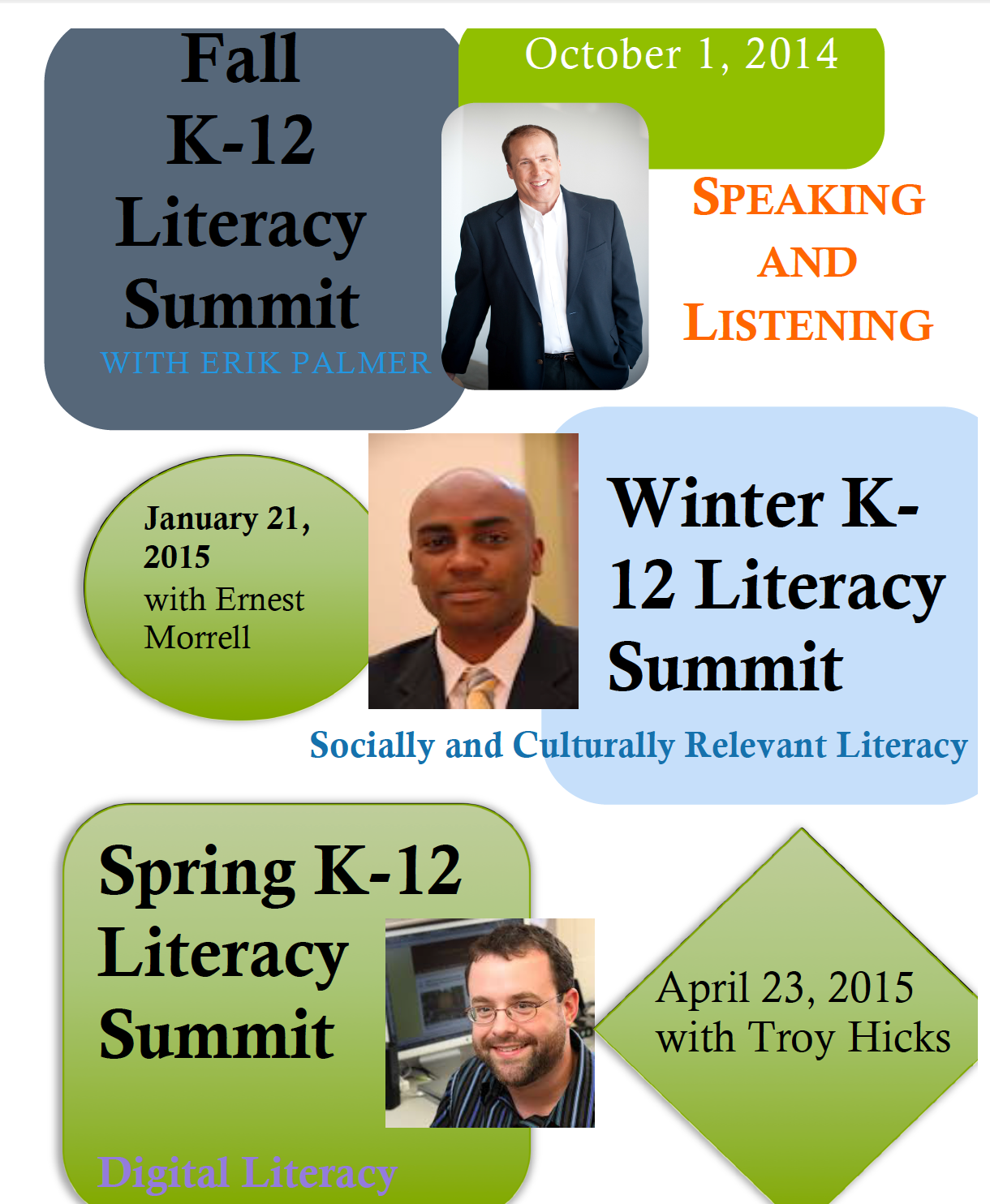
        K-12 Literacy Summits

        Existing literacy networks at WISD, Study of Early Literacy (SOEL) Reading Apprenticeship (RA), and Writing Collaborative (WC), each focus on particular elements of literacy instruction and grade levels.  However, the literacy umbrella is wide, and often topics arise that are of interest and importance to teachers of all subject areas and grade levels.


               The K-12 Literacy Summits scheduled for this year will bring together K-12 educators on:

        • Speaking and Listening: October 1, 2014 with ASCD author Erik Palmer


        • Socially and Culturally Relevant Literacy: January 21, 2015 with Dr. Ernest Morrell of Columbia University.

        • Digital Literacy: April 23, 2015 with Dr. Troy Hicks of Central Michigan University
        K-12 Literacy Summits.png


        Contact Melissa Brooks-Yip with questions: 734-994-8100 X1266 or   mbrooksyip@washtenawisd.org

        Tuesday, September 2, 2014

        September

        Building Classroom Libraries

        for all grades and all subjects!


        We should be curators of our libraries, not just collectors. Offering students an engaging, diverse classroom library requires more than buying books and putting them on bookshelves . . . managing a classroom library requires curation -- selecting the best most current materials for both curriculum needs and student interests.         -Donalynn Miller
        If you are wondering how to get started on a classroom library, how to strengthen your existing one, or how to create reading nooks, check out these articles by Choice Literacy teachers:
        Reading Nooks

        *************************************************

        Bring TED to your classroom with TED-Ed Clubs!

        TED-Ed Clubs is a flexible, school-based program that supports students in discussing, pursuing and presenting their big ideas in the form of short TED-style talks. Watch the video or check the site to learn more.  


        ********************************************************

        Wednesday, July 30, 2014

        August

        Books for Back to School!

        Reading about going back to school is a great way to ease the transition. No matter what age, read alouds can get you and your students back into the school mindset.
        To get you started, here are some suggestions for children of elementary school age:
        • The Berenstain Bears Go to School. Berenstain, Stan and Jan. Random House, 1978.
        • Arthur's Teacher Trouble. Brown, Marc. Trumpet, 1986.
        • Clifford's First School Day. Bridwell, Norman. Scholastic, 1999.
        • Never Spit on Your Shoes. Cazet, Denys. Scholastic, 1993.
        • Get Ready for Second Grade, Amber Brown. Danziger, Paula. Puffin, 2003.
        • Kindergarten Rocks! Davis, Katie. Harcourt Children's Books, 2005.
        • Back to School for Rotten Ralph. Gantos, Jack. HarperTrophy, 2000.
        • Back to School with Betsy. Haywood, Carolyn. Odyssey Classics, reissue edition, 1990.
        • Chrysanthemum. Henkes, Kevin. HarperTrophy, 1996.
        • The Day the Teacher Went Bananas. Howe, James. Penguin, 1987.
        • It's Back to School We Go! Jackson, Ellen. Millbrook Press, 2003.
        • Sumi's First Day of School Ever. Pak, Soyung. Penguin Putnam Books, 2003.
        • Amelia Bedelia Goes Back to School. Parish, Herman. Harper Festival, 2004.
        • Curious George Goes to School. Rey, Margret. Houghton Mifflin, 1989.
        • The Best School Year Ever. Robinson, Barbara. HarperTrophy, reprint edition, 2005.
        • Miss Bindergarten Gets Ready for Kindergarten. Slate, Joseph. Puffin Books, 2001.
        • The Teacher from the Black Lagoon. Thaler, Mike. Scholastic Paperbacks, 1989.
        • The Night Before Kindergarten. Wing, Natasha. Grosset & Dunlap, 2001.

        For Middle and High School Students:

        • The Middle School Survival Guide : How to Survive from the Day Elementary School Ends until the Second High School Begins. Erlbach,Arlene. Walker Books for Young Readers, 2003.
        • High School Bound: The Ultimate Guide for High School Success and Survival. Spethman, Martin J. and Klein, Chuck. Westgate Publishing & Entertainment, 1997.
        • The Real High School Handbook : How to Survive, Thrive, and Prepare for What's Next. Lieberman,Susan Abel. Mariner Books, 1997.

        *from greatschools.org
        ____________________________________________________________________________________

        Fall Professional Development on Literacy


        Writing Collaborative: 

         October 21, 22 and November 6    Register HERE


        Reading Apprenticeship: 

        September 16, 17 and October 9     Register HERE


         K-12 Fall Literacy Summit 

        Erik Palmer on Speaking and Listening


             October 1, 2014 from 8:30-3:30 at WISD
           If you are an active member of a literacy network (RA, WC or SOEL), or an administrator who supports a teacher in one of these networks, you are invited to PRE-REGISTER for this event. 

        *  This fall, remaining spots will be opened to those outside the networks for a small fee.

        Thursday, June 26, 2014

        July


        Looking Ahead to Fall Professional Development

        Save the Dates!

        Writing Collaborative:  October 21, 22 and November 6

        Reading Apprenticeship:  September 16, 17 and October 9

             **Registration info. to come as WISD installs a new system.


         K-12 Fall Literacy Summit 

        featuring Erik Palmer on Speaking and Listening


             October 1, 2014 from 8:30-3:30 at WISD
           If you are an active member of a literacy network (RA, WC or SOEL), or an administrator who supports a teacher in one of these networks, you are invited to PRE-REGISTER for this event. 

        *  This fall, remaining spots will be opened to those outside the networks for a small fee.


        Friday, May 30, 2014

        June

        How to Teach Listening in the Digital Age

            Knowing that speaking and listening are important literacy skills, but often not incorporated into curriculum, Erik Palmer, consultant with ASCD, developed a media literacy unit entitled "Listening in the Digital Age."  Erik answers questions such as Who teaches students to evaluate sound? Who teaches students to evaluate images? Who teaches students to evaluate video?  Read Erik's whole article here.  He will be coming to WISD on October 1st for a workshop on his speaking and listening framework for the K-12 classroom! (more info. to come this fall).

        Using Text Sets to Support Common Core Implementation

            Students need to be able to critically think about increasingly complex texts and to read across informational and literary texts. Building strong text sets can be one way of supporting teachers in providing the necessary reading experiences. A text set is a group of books used to build background knowledge and common vocabulary around a theme or topic. 
            In the text set an anchor book is used as the focus of a unit or lesson and a series of additional information at various reading levels is strategically chosen to support the anchor text. The materials available at the Library of Michigan MDE site explain how the sets can be created and used.   You will also find text sets listed here in this growing resource site. 


        Upcoming Professional Development


        Thursday, May 1, 2014

        May

        Apps to Assist in Everyday Literacy Tasks

        These are useful for communicating, collaborating, note-taking and annotating.

        Pocket  helps manage your readings.  If you get numerous online reading suggestions per day or week, this is a great tool to manage them and keep them all in one place. It has a "night" function that dims the screen.

        GroupMe allows you set up a private group for text messaging.  A class could have its own GroupMe discussion space, and then students can send each other reminders, ask each other questions, etc.  This tool allows the class to communicate with each other inside and outside of classroom hours, and the students can go to each other for help. Works on phones, mobile devices like iPads or iPods, and computers, so students don't need a smart phone.

        Remind101 allows you to send texts to students without seeing each other's phone numbers.  Several teachers use this one to send reminders like "First draft due tomorrow, and don't forget the Works Cited page."


        Evernote is more of a "one-stop-shopping" app.  It lets you manage notes, images, readings, and more all in one place.  It has a free level and then for pay you get additional capabilities.  

        Subtext  Subtext is a digital reading program built for K12 classrooms. Read and collaborate with your classroom for free  by creating private groups, embedding discussion, finding content, researching, annotating and more. 

        *Thanks to RCWP teachers and Chelsea Writing Collaborative teachers for sharing! 

        Literacy Professional Development Offerings this Summer

        • Inkstains- A summer writing camp for middle and high school students- located at EMU.


        End-of-Year Writing and Summer Reading

             Read what literacy consultant Franki Sibberson suggests for some thoughtful literacy activities for the end of the school year and some non-fiction, picture books, YA novels and inspirational texts for all readers this summer. 


        Ending the Year with Literacy Gifts


        Football Field Writing


        Monday, March 31, 2014

        April

        April is National Poetry Month! 

        NATIONAL POETRY MONTH is not just for English teachers! 

        Inspire the Next Poet Laureate!
             Inaugurated by the Academy of American Poets in 1996, National Poetry Month is now held every April, when schools, publishers, libraries, booksellers and poets throughout the country join to celebrate poetry and its vital place in American culture. Thousands of organizations participate through readings, festivals, book displays, workshops, and other events. Here are some helpful links.
         Edutopia offers a number of resources, including perspectives on how to teach poetry, classroom activities, and inspirational videos. 

        • At the American Academy of Poets, educators can sign up to get a free poster and check out other resources celebrating the event, including 30 ways to celebrate poetry.

        • The National Poetry Foundation houses many helpful tools online, including Poetry Magazine, monthly podcasts (try "Without the Blues There Would Be No Jazz"), poetry tours of cities, information about how your class can participate in the national poetry contest, Poetry Out Loud, and a browser to search poets and poetry by genre.  


        • The Library of Congress offers Poetry 180, a poem a day for American high school students. 

        Writing in the Digital Age

             In this Edutopia Big Thinkers video, Elyse Eidman-Aadahl, co-director of the National Writing Project, talks about writing in the digital age and how writing has evolved.  How has communication through writing changed?  As you watch and listen to Elyse, think about how this applies to your classroom, your students, and your teaching. 


        Professional Development

        Writing Collaborative (grades 4-12)

        • April 29, 30, and May 16, 2014 at WISD 8:30-3:30 
                                                         OR
        •  June 18, 19, 20  2014 at WISD 8:30-3:30
        *All details, costs, and registrations can be found on WISDGoSignMeUP!
        ____________________ 

        Reading Apprenticeship (grades 4-12)

        April 22, 23 and May 14, 2014 at WISD 8:30-3:30 

                                       OR 

        June 24, 25, 26 at WISD 8:30-3:30 

        *All details, costs, and registrations can be found on WISDGoSignMeUP!

        Questions?  Contact mbrooksyip@wash.k12.mi.us 

        Saturday, March 1, 2014

        March

        Literacy Education in the United States

        Remodeling Literacy Learning Together

             The National Center for Literacy Education (NCLE) has shown that educators' most powerful learning experiences come from working with their colleagues.  In a recent survey, NCLE wanted to find out if schools and districts are taking a capacity building or incentive driven approach to putting the CCSS for literacy in place. The graphic below illustrates their findings:
        *See that entire report HERE
        ____________________________________________________

        Literacy Initiatives at WISD

             On February 27th, teachers of all subject areas, instructional coaches, and administrators met with Literacy Leaders of Washtenaw and Livingston counties to plan for literacy instruction implementation in their buildings.  If you missed it, please view the highlights below for updates on Writing Collaborative and Reading Apprenticeship. 


        *Upcoming Writing Collaborative and Reading Apprenticeship Training for Teachers:


        __________________________________________________

        Cool Websites for Literacy Integration

        NEWSELA
          Would you like unlimited access to hundreds of leveled news articles? Newsela has new CCSS aligned articles everyday and it is free! 

        Graph of the Week
        Part of being literate means being able to read, comprehend, and write about graphs.  Graph of the Week  provides graphs, questions for reading and thinking about them, and writing prompts for each graph, and it is all free! 
        *Thanks to Brandon Szwejkowski of Milan Area Schools for sharing these at our Writing Collaborative meeting! 

        ______________________________
        Other Literacy PD this Spring & Summer

        • Inkstains- A summer writing camp for students middle and high school students.